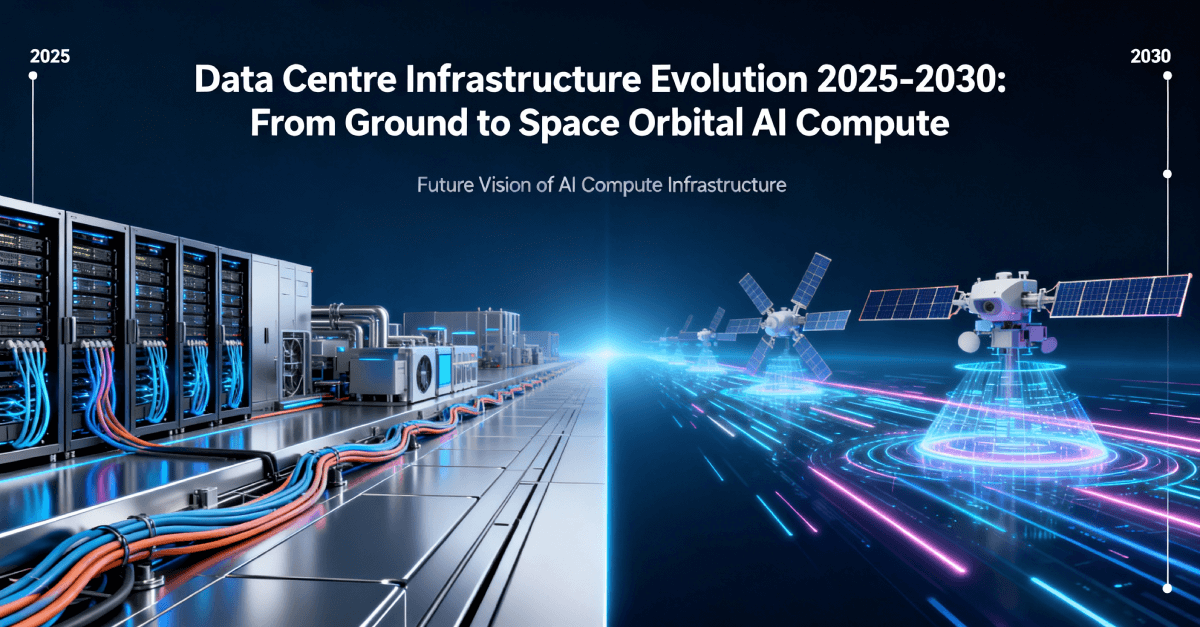
Over the next five years the world will pour between 5–7 trillion dollars into data‑centre and compute infrastructure as AI reshapes every industry. At the same time, terrestrial power grids are straining, water and land are becoming political flashpoints, and the industry is already experimenting with orbital data centres powered by space solar.
For India, this is not just a technology story. It is a once‑in‑a‑generation infrastructure and talent opportunity: moving from an under‑served cloud market to a global AI compute hub.
The Global Compute Shock: 2025–2030 by the Numbers
The data‑centre industry is transitioning from “supporting IT” to becoming the core of the global energy and capital stack.
Key global metrics for 2025–2030:
The global data‑centre market is expected to grow from about USD 418 billion in 2025 to nearly USD 692 billion by 2030, a CAGR of around 10–11%.
Longer‑term forecasts see the market reaching ~USD 988 billion by 2035 at similar growth rates.
Within this, the AI data‑centre segment is projected to explode from ~USD 236 billion in 2025 to ~USD 934 billion by 2030, growing at 31–32% CAGR.
On the capex side, McKinsey estimates that meeting compute demand by 2030 will require USD 6.7–7 trillion of cumulative investment, of which USD 5.2 trillion is specifically AI‑oriented data‑centre capex.
In capacity terms, McKinsey projects 156 GW of AI data‑centre capacity demand by 2030, with about 125 GW of incremental AI capacity added between 2025 and 2030 alone. To put this in perspective, that is like adding the current total global hyperscale footprint several times over in just six years.
The Real Bottleneck: Power, Not GPUs
Peter Diamandis highlights a crucial point: the constraint is no longer chips or capital – it is power.
Recent research from Goldman Sachs and S&P shows:
Data‑centre power demand is expected to rise about 165% by 2030, driven largely by AI workloads.
S&P projects that global data‑centre electricity use could nearly double by the end of this decade, putting enormous pressure on grids and forcing utilities to accelerate new generation and transmission.
In practice, this means:
Major cloud providers already face permits and grid‑connection delays in the US and Europe.
In markets like India, the constraint is increasingly a three‑way trade‑off between power, water and community acceptance, as seen in recent coverage of the water footprint of hyperscale facilities.
This is the backdrop against which orbital data‑centre concepts – powered by uninterrupted solar in space – start to look less like science fiction and more like an inevitable extension of the energy‑compute race.
India’s Data‑Centre Decade: From Undersupplied to AI Hub
India today has roughly 1.5–1.8 GW of operational data‑centre capacity, a fraction of the US footprint but one of the fastest growth trajectories in the world.
Multiple independent analyses converge on the same outlook:
Capacity: India’s data‑centre capacity is expected to reach 8–9 GW by 2030–2032, a 5x increase versus 2023.
Investment: This build‑out requires USD 30–35 billion of capex this decade, with some estimates calling the current wave “India’s USD 30 billion data‑centre gold rush.”
Drivers include:
Data‑localisation requirements and the Digital Personal Data Protection Act.
India’s role as a preferred alternative to China for hyperscalers and cloud‑native AI providers.
A demographic and digital profile of 1.4 billion people, rapidly digitising finance, retail, health and government services.
At the same time, India’s grid is still building out: S&P notes that India’s datacentre growth path will succeed only if renewables, grid capacity and policy execution keep pace.
Investor Lens: Why Data Centres Are the New Core Infrastructure
For global capital, data centres now look like a hybrid of real estate, infrastructure and technology – with return profiles that are hard to match elsewhere.
Selected benchmarks:
Acquisition multiples for mature platforms have consistently traded at 25–30x EBITDA, compared with around 16x for typical infrastructure assets.
Equity investors in data‑centre projects often target 15–20% internal rates of return (IRR); debt providers are comfortable at 5–6% coupons, even in a higher‑rate environment.
Recent market commentary highlights stable 20–30% EBITDA margins and high occupancy, particularly in Tier‑1 markets and AI‑optimized facilities.
For India, this means:
Well‑structured projects around Mumbai, Chennai, Hyderabad, Bengaluru and the new Andhra Pradesh corridor can realistically offer mid‑teens to high‑teens equity IRR, especially when combined with renewable PPAs and long‑term AI or cloud anchor tenants.
The combination of low cost per MW (land + labour + power) and high global demand for GPU capacity positions India as one of the most attractive regions globally on a risk‑adjusted basis.
From Ground to Orbit: The Emerging “Space Data‑Centre” Thesis
The Diamandis article pushes the conversation beyond Earth:
The US already hosts over 5,400 data centres, more than the rest of the world combined – yet is hitting limits on land, power and permits.
Leaders like Eric Schmidt argue that AI’s real bottleneck is not GPUs but power and energy delivery.
Enter space‑based data centres, powered by continuous solar in orbit, with no atmosphere, no night, no weather – and minimal terrestrial regulation.
Key developments:
Starlink V3: SpaceX plans Starlink V3 satellites delivering 1 Tbps each. With 60 satellites per Starship launch, that is 60 Tbps of orbital compute/communications capacity per flight, on a weekly cadence.
Lunar manufacturing vision: Musk has floated the idea of a lunar base producing solar‑powered AI satellites, accelerated into orbit via electromagnetic mass drivers – aiming at 100 terawatts per year of space‑based power and compute.
Bezos and Schmidt:
Jeff Bezos has spoken about gigawatt‑scale orbital data centres within 10–20 years.
Eric Schmidt’s investment in Relativity Space is positioned explicitly to support a space‑data‑centre vision.
Starcloud & Crusoe: Starcloud‑1 has already flown an NVIDIA H100 GPU into orbit as a proof of concept. Crusoe and Starcloud plan the first public cloud in space by 2027, with Crusoe Cloud workloads running on Starcloud satellites.
Framed against the Kardashev Scale, these are early but concrete steps toward a Type I civilization – one that uses all the energy available on its home planet
For terrestrial data‑centre strategists in India, this is not a distraction. It is a signal:
The world will not slow AI to fit the grid; it will re‑engineer energy and compute architectures – on Earth and beyond – to fit AI.
Nations that master efficient, low‑carbon, high‑density data‑centre engineering today will be natural partners and platforms for off‑planet compute tomorrow.
What This Means for India – And Where to Focus
Taken together, the numbers suggest five strategic imperatives for India’s data‑centre and AI ecosystem:
Grid + Renewables First
AI will push India’s data‑centre power demand sharply higher in metro clusters. Planning must integrate renewable PPAs, storage, and transmission upgrades upfront to avoid the bottlenecks now visible in the US and Europe.
Water‑Smart Design
With growing scrutiny of water use in regions like Maharashtra and Tamil Nadu, liquid cooling, recycled water, and coastal siting with desalination will become differentiators, not extras.
AI‑Optimised Facilities
New builds need to support 80–120 kW per rack, advanced immersion or direct‑to‑chip cooling, and GPU‑dense architectures, so they can command the valuation and pricing premiums now emerging in AI‑grade facilities.
Policy and Sovereignty
Data‑localisation, DPDP, and “trusted partner” positioning make India a natural regional hub for APAC, the Middle East and Africa – especially as subsea cable routes diversify around geopolitical choke points.
Talent as the Ultimate Bottleneck
McKinsey and Uptime Institute both point to chronic global shortages of skilled data‑centre engineers, technicians and operators over the rest of this decade. Scaling from ~1.5 GW to 8–9 GW implies tens of thousands of new specialised roles in India, across power, cooling, network, security and AI operations.
This is precisely where India – and companies like yours – can lead.
Best NanoTech: Building the Human Layer of the AI Infrastructure Stack
At the base of every GW of compute is human expertise: design engineers, construction managers, controls specialists, reliability engineers, GPU and network operations teams.
Best NanoTech specialises in supplying this talent across the full spectrum of next‑generation infrastructure:
Data Centres and AI Infrastructure
OpenAI / Generative‑AI Platforms
Power and Grid‑Scale Energy
Clean Energy and Renewables
Semiconductor and Advanced Electronics
Core TECH and Enterprise IT
Our services include:
Permanent Recruitment
Contract & Staff Augmentation
Payroll & Managed Services
Project‑Based Hiring for Build‑outs and Migrations
GCC / Global Capability Centre Build‑outs
Specialist Data‑Centre Hiring (design, construction, operations)
As India races from gigawatts on the ground to terabits – and eventually terawatts – in orbit, the real competitive edge will be the quality, depth and speed of talent deployment.
Best NanoTech is focused on ensuring that edge belongs to India.